The model provides the intelligence. MCP provides a standardized way to reach the tools and context required to act.
Artificial intelligence is becoming increasingly capable. Modern AI systems can write code, analyze documents, answer complex questions, reason through problems, and assist with sophisticated workflows.
But intelligence alone is not enough.
Imagine asking an AI assistant to check the latest issue assigned to you, review the related documentation, inspect the repository, and draft an update for your team. The AI may understand exactly what you want, but the information it needs could be spread across GitHub, Linear, Notion, Google Drive, or internal company tools.
For the AI to actually complete the task, it needs a reliable way to interact with those systems. This is the problem Model Context Protocol (MCP) was designed to solve.
What Is MCP?
MCP stands for Model Context Protocol. MCP is an open standard that provides a common way for AI applications to connect to external tools, services, and data sources.
A useful analogy is USB-C for AI applications. Instead of every AI application requiring a completely custom integration for every external system, MCP defines a standard way for AI applications and external tools to communicate.
The Basic MCP Connection
The connection runs from the AI application, through its MCP client and an MCP server, to the external system:
AI application
Claude, Codex, an AI assistant, or another MCP-capable application
MCP client
The part of the AI application that connects to and communicates with MCP servers
MCP server
Exposes tools, resources, and capabilities through the MCP standard
External system
GitHub, Notion, Linear, Gmail, a database, an internal API, or another service
Understanding MCP Clients and MCP Servers
MCP Client. The MCP client is typically part of the AI application that wants to access external capabilities. It connects to MCP servers, discovers what they provide, and enables the AI model to use those capabilities when necessary.
MCP Server. An MCP server exposes tools, resources, or other capabilities to an AI application. A GitHub MCP server, for example, might let an AI inspect repositories or retrieve issues. A database MCP server could expose controlled database operations, while an internal MCP server could expose company-specific APIs and workflows.
Why MCP Matters
Without a common protocol, connecting AI applications to external systems can quickly become difficult to manage. A developer may use GitHub for source code, Linear for issue tracking, Notion for documentation, Gmail for communication, internal APIs, and databases.
MCP helps by introducing a common communication standard. Instead of designing an entirely new AI integration pattern every time, developers can build or use MCP servers that expose capabilities through the same protocol.
This also helps move AI beyond simply generating information toward interacting with systems. A model may already understand code; with the right MCP tools, it can also inspect the repository containing that code. It may understand project management; with the right connection, it can retrieve the actual issues assigned to a developer.
But MCP Introduces Another Challenge
MCP solves an important integration problem, but as organizations begin using more MCP servers, another problem appears: how do you manage all of them?
A developer may start with one MCP server, then add GitHub, Notion, Linear, Gmail, databases, internal APIs, cloud infrastructure, analytics tools, and more. Different AI applications may also need different combinations of these servers.
At that point, the challenge is no longer simply, How do I connect my AI to a tool? It becomes, How do I organize, access, manage, and reuse all the MCP capabilities my AI applications need?
That is the problem Synaxis is being built to address.
Where Synaxis Comes In
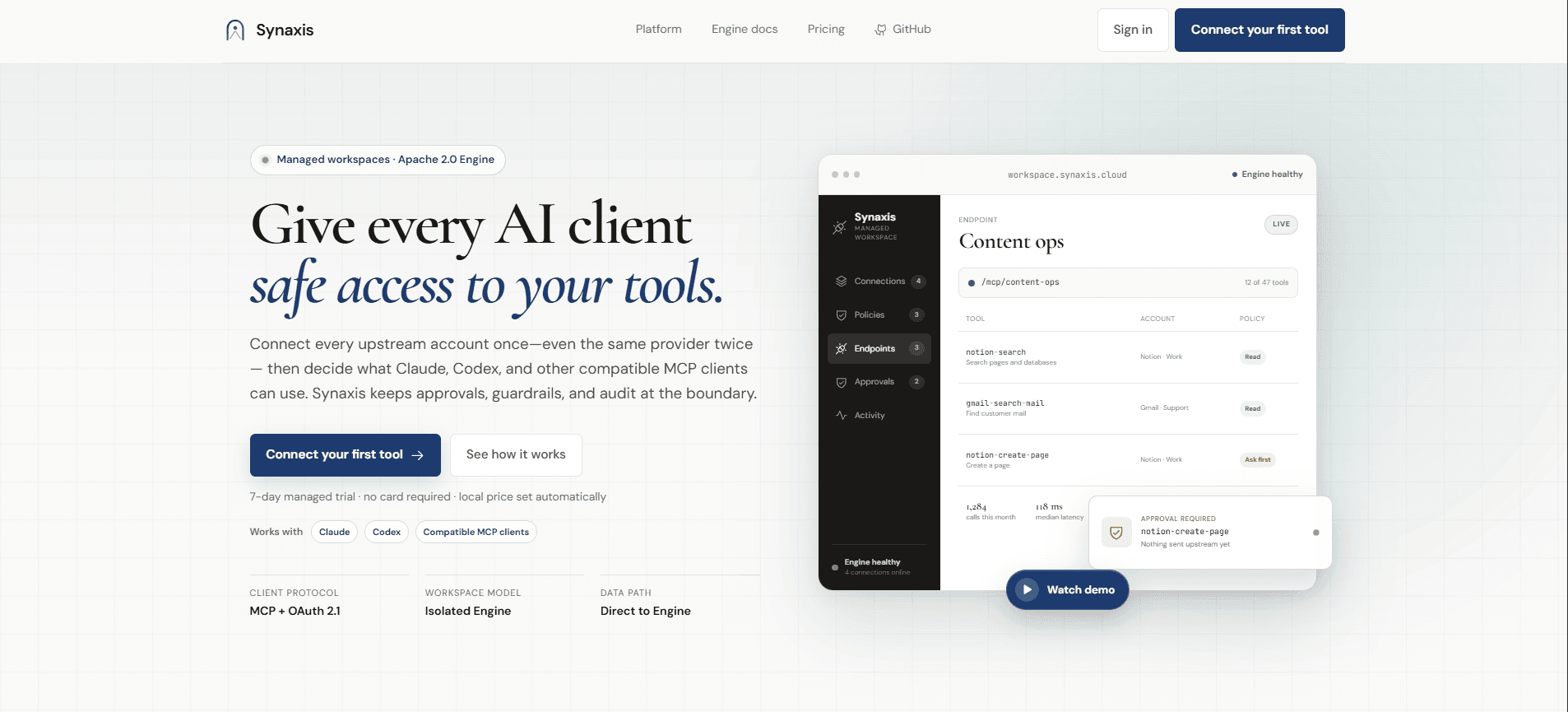
Synaxis provides infrastructure for organizing and accessing MCP capabilities across AI applications. Rather than thinking of Synaxis as another AI agent, think of it as the tool infrastructure behind your AI agents.
Your AI applications provide the intelligence. MCP provides the communication standard. Synaxis helps provide the infrastructure through which those MCP capabilities can be organized and accessed.
How Synaxis Fits into the MCP Ecosystem
AI applications access MCP capabilities through Synaxis, which sits between the applications and the tools they need:
Claude
AI application
Codex
AI coding agent
AI agents
Custom assistants
Other MCP clients
MCP-capable apps
Synaxis
A centralized infrastructure layer for organizing and accessing MCP capabilities
GitHub MCP
Notion MCP
Linear MCP
Gmail MCP
Database MCP
Internal APIs
Cloud tools
Other MCPs
Synaxis Has Two Sides
Synaxis Engine
Open source. The core infrastructure for developers and organizations that want to inspect, customize, self-host, and operate Synaxis themselves.
Synaxis Platform
Managed experience. A managed environment designed to make it easier for teams to configure, organize, and use MCP capabilities without operating all of the infrastructure themselves.
Synaxis Engine = the open-source infrastructure. Synaxis Platform = the managed Synaxis experience.
MCP Is the Beginning, Not the End
MCP is helping create an important standard for how AI applications interact with the outside world. As adoption grows, AI applications will increasingly be able to discover and use tools rather than operating as isolated systems.
But that creates the next infrastructure challenge. When an AI application needs one MCP server, managing the connection is relatively simple. When developers and organizations depend on dozens - or eventually hundreds - of MCP capabilities across different AI applications, managing that ecosystem becomes a problem of its own.
That is where Synaxis comes in.
MCP provides the standard that allows AI and tools to communicate. Synaxis is building the infrastructure for managing and accessing that growing world of MCP capabilities. With the open-source Synaxis Engine, developers can build and operate that infrastructure themselves. With the Synaxis Platform, teams can use a managed experience designed to make working with MCPs easier at scale.
Your AI has the brain. Synaxis gives it the toolbox.
MCP creates the connection. Synaxis helps make those connections manageable.